
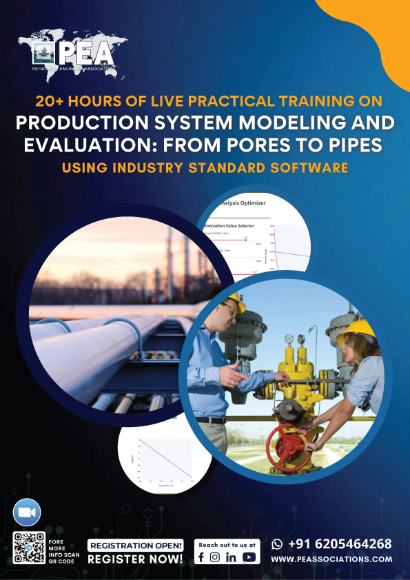
Integrate Reservoir, Wellbore, and Surface Network Modeling for Optimized Production Performance
Production System Modeling and Evaluation from Pores to Pipes Using Industry Standard Software
Gain practical experience in end-to-end production system analysis from pore-scale flow to surface facilities using leading industry simulation tools.



Production System Modeling and Evaluation from Pores to Pipes Using Industry Standard Software
Have Questions ?
Production System Modeling and Evaluation from Pores to Pipes Using Industry Standard Software - PEA-PS26
| Code | Date | Time | Duration | Location | Currency | Team of 10 Per Person | Team of 7 Per Person | Early Bird Fee Per Person | Normal Fee Per Person |
|---|---|---|---|---|---|---|---|---|---|
| PEA-PS26 | 16 - 27 Mar 2026 | 9:30 PM Indian Time |
2 Hours Per Day
|
Zoom Online
|
USD
|
2000
|
2200
|
2500
|
3000
|
The classes will be via zoom online from monday to friday with 2 hours / day.
Boost your team's skills and your budget! Enjoy group discounts for collaborative learning. Send an inquiry to info@peassociations.com.
Production System Modeling and Evaluation From Pores to Pipes Using Industry Standard Software
This course provides a comprehensive understanding of integrated production system modeling and evaluation across the entire hydrocarbon value chain. Participants will learn how to analyze, simulate, and optimize production performance from reservoir to surface network using industry-standard software tools.
Description
The Production System Modeling and Evaluation from Pores to Pipes course focuses on building an integrated understanding of the complete production system connecting the reservoir, wellbore, and surface facilities into a unified model. Participants will learn how to apply system analysis techniques to identify bottlenecks, evaluate production scenarios, and optimize flow efficiency across all components of the system.
Through the use of industry-standard software, this course provides hands-on experience in modeling multiphase flow, well performance, artificial lift, and surface network hydraulics. Participants will work through practical exercises that simulate real-world field situations, enabling them to translate theoretical concepts into operational improvements.
By the end of the course, participants will be equipped with the skills to design, analyze, and optimize production systems for enhanced recovery and reduced operational costs.
Effective production system modeling is essential for maximizing field performance and ensuring the economic success of oil and gas operations. Modern digital tools allow engineers to model complex interactions between reservoirs, wells, and surface networks to make informed operational and design decisions.
This course introduces the integrated “pore-to-pipeline” approach, enabling participants to visualize and evaluate the complete production system as a single entity. By combining field data, reservoir performance, and surface constraints, participants learn how to identify optimization opportunities and develop data-driven solutions that improve production efficiency.
By the end of this course, participants will be able to:
-
Understand the fundamentals of integrated production system modeling and nodal analysis.
-
Build and calibrate reservoir-to-surface network models using industry-standard software.
-
Evaluate well performance and diagnose production bottlenecks.
-
Apply multiphase flow and pressure drop correlations effectively.
-
Integrate artificial lift, well completion, and surface facility data into system models.
-
Conduct sensitivity analysis and optimize system parameters for maximum efficiency.
-
Interpret simulation results to guide operational and investment decisions.
This course employs a hands-on, practical approach using industry-standard production modeling software. It combines technical presentations, guided software exercises, case studies, and interactive discussions. Participants will perform real-time simulations, analyze results, and develop optimization strategies that reflect real operational challenges.
Organizations that implement the skills taught in this course will benefit through:
-
Improved integration between reservoir, well, and surface network operations.
-
Enhanced production optimization and field management capabilities.
-
Reduced downtime and production losses through data-driven analysis.
-
Better decision-making supported by accurate and dynamic system models.
-
Increased profitability through improved field performance and cost efficiency.
Participants will gain:
-
Practical experience using professional production system modeling tools.
-
Deeper understanding of the entire production chain from reservoir to pipeline.
-
Enhanced analytical and problem-solving skills for real-world field scenarios.
-
The ability to interpret and act on simulation results confidently.
-
Broader technical competence to support integrated asset modeling and optimization.
This course is designed for professionals involved in production engineering, reservoir management, and system design, including:
-
Production and Petroleum Engineers
-
Reservoir Engineers and Simulation Specialists
-
Well Performance and Optimization Engineers
-
Facilities and Process Engineers
-
Field Development and Operations Personnel
-
Technical Advisors and Project Managers
MODULE 1: GET TO KNOW THE SOFTWARE
• Introduction to State of Art Multiphase Flow Simulator
• Basics of Production System Components
• Touring the GUI
• An Introduction to Simulation Tasks
• Files, Project, Plugins and other Structures in Software
• Exercise No. 1: Running a finished Model.
MODULE 2: THE FLOW PHENOMENON
• Single phase flow modeling
• Exercise No. 2: Basic Surface Flow Model
• Exploring Results and Plots
• Introduction to Fluid Modeling
• Exercise No.3: Working with EOS, BO Models
• Heavy Oil Production and Transportation
MODULE 3: OIL WELL MODELING BASICS
• Introduction to System Analysis (NODAL)
• Building Oil Well Models
• Exercise No. 4: Representing Reservoir In Oil Wells
• Introduction to Multiphase flow Models
• Sensitivity and Parametric Studies
• Exercise No. 5: Modeling high Water wells
• Exercise No.6: Effect of various production parameters on modeling
MODULE 4: GAS WELL MODELING, INJECTION WELL MODELING
• Building Compositional Fluid Models
• Deliverability in gas wells
• Liquid Loading in Gas Wells
• Exercise No. 7: Evaluating unloading velocity in gas producing wells
• Exercise No.8: Water Injection Well performance evaluation
• Introduction to choked flow
• Exercise No.9: Choke Modeling in multiphase producing wells
• MODULE 5: SURFACE NETWORKS AND FLOW ASSURANCE
• Modeling Surface Gathering Lines
• Nodes, Junctions and Boundary Conditions
• Exercise No. 10: Water Injection Network
• Exercise No. 11: Oil Production Network
• Steady State Flow Assurance Modeling in Software
• Exercise No. 12: Slugging in pipelines
On successful completion of this training course, PEA Certificate will be awarded to the delegates.
Mr. Nashat J. Omar With over 12+ years of specialized experience in petroleum engineering, focus on production and flow assurance brings valuable expertise to the energy sector.
He possess a strong command of Python and C#, which empowers him to create efficient data management solutions and streamline workflows.
His collaborative nature and adaptability enable him to thrive in multidisciplinary settings, where he consistently contributes to success through innovative problem-solving.
He is dedicated to continuous learning and staying ahead of industry advancements, ensuring that he can enhance operational efficiency and guarantee robust flow assurance.
Frequently Asked Questions
All course bookings made through PEA are strictly non-refundable. By registering for a course, you acknowledge and accept that all fees are payable in full and are not subject to refund under any circumstances, including changes in personal or professional commitments or partial attendance.
PEA reserves the right to make reasonable adjustments to course content, trainers, or schedules where necessary, without entitling delegates to a refund. Comprehensive details of each course — including objectives, target audience, and content — are clearly outlined before enrolment, and it is the responsibility of the delegate to ensure the course's suitability prior to booking.
For any inquiries related to cancellations or bookings, please contact our support team, who will be happy to assist you.
You may also be interested in...