
Optimize Flow Efficiency and Production Integrity in Oil and Gas Operations
Oil and Gas Flow Assurance and Production Chemistry
Master the principles of flow assurance and production chemistry to maintain seamless and efficient oil and gas processes.



Oil and Gas Flow Assurance and Production Chemistry
Have Questions ?
Oil and Gas Flow Assurance and Production Chemistry - PEA/FAP/26
| Code | Date | Time | Duration | Location | Currency | Team of 10 Per Person | Team of 7 Per Person | Early Bird Fee Per Person | Normal Fee Per Person |
|---|---|---|---|---|---|---|---|---|---|
| PEA/FAP/26 | 03 - 07 Aug 2026 | 9 PM Indian Time |
4 Hours Per Day
|
Zoom Online
|
USD
|
1500
|
1850
|
2000
|
2500
|
Boost your team's skills and your budget! Enjoy group discounts for collaborative learning. Send an inquiry to info@peassociations.com.
Oil and Gas Flow Assurance and Production Chemistry
This course provides a comprehensive understanding of flow assurance and production chemistry, emphasizing techniques to mitigate flow-related issues and enhance operational efficiency in oil and gas production. Through expert-led instruction, participants will gain insights into practical solutions for real-world challenges in flow assurance and production chemistry.
Description
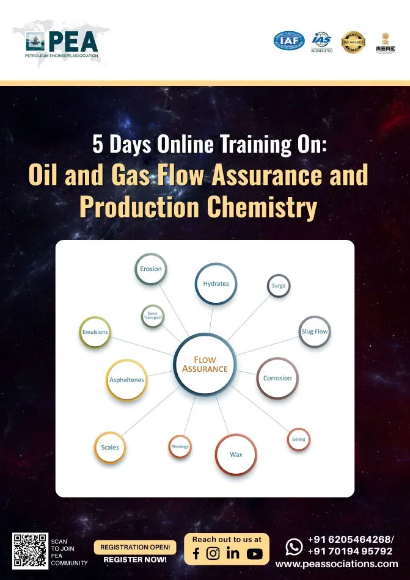
In the Oil and Gas Flow Assurance and Production Chemistry course, participants will learn critical strategies to address flow assurance challenges and production chemistry concerns. The course covers topics like hydrates, asphaltenes, wax deposition, corrosion, scale management, and more. Attendees will develop the skills necessary to prevent and resolve flow disruptions, ensuring optimal production and operational continuity. Using real-world examples, case studies, and interactive sessions, the course prepares participants to make informed decisions in flow assurance and production chemistry.
Demo Class
Flow assurance and production chemistry are vital for maintaining the uninterrupted, safe, and efficient operation of oil and gas production systems. This course delves into the chemistry and engineering solutions required to address challenges such as blockages, corrosion, and other flow-related issues that can impact production. Through a balanced mix of theory and practical application, participants will gain the expertise to diagnose and mitigate these issues effectively.
Acquire a comprehensive understanding of the fundamental principles of flow assurance.
Identify the main flow assurance and production chemistry issues.
Understand fluids equilibrium during production and gain the key practical skills for fluids sampling, analysis, and their methodologies.
Gain practical skills in modeling and simulation.
Gain the key skills to conduct robust risk assessment, implement effective treatment, and process monitoring.
Gain essential skills in lab and process integration and data management.
This course employs a blend of interactive lectures, case studies, group discussions, and practical exercises. Participants will gain hands-on experience in identifying and addressing flow assurance issues through simulations and real-world problem-solving techniques.
Reducing downtime and maintenance costs through effective flow assurance practices.
Enhancing production efficiency and minimizing operational risks.
Ensuring a proactive approach to production chemistry challenges.
Improving asset longevity and performance.
Practical knowledge of flow assurance and production chemistry techniques.
Enhanced decision-making skills in addressing flow disruptions and production challenges.
A deeper understanding of the chemistry and engineering principles critical to their roles.
Increased confidence in managing flow assurance risks and solutions.
Production technicians
OIMs, Supervisors, and area managers
Production engineers
Reservoir engineers
Account managers
Production chemists
Lab chemists
Microbiologists
Corrosion engineers
Students and interns
Day 1:
Introduction to Flow Assurance & Scale Management
Introduction to flow assurance and production chemistry
Overview of oil and gas production systems
Understanding production fluids and phase equilibrium
Concept and importance of flow assurance in oil and gas systems
Fluids hydrodynamics and multiphase flow problems
Origins of production chemistry problems
Mineral scales: formation, types, mechanisms, and impact on operations
Scale risk assessment, analysis, prediction, and monitoring methods
Scale mitigation: operational, chemical (inhibitors), non-chemical, and removal methods
Designing and implementing an efficient scale management strategy
Case studies on wax, asphaltenes, emulsions, corrosion, gas hydrates, MIC, biofouling, sand production, and slugging
Day 2:
Gas Hydrates, Wax, and Asphaltenes
Gas hydrates: formation mechanisms, risk factors, and operational impacts
GH prediction, monitoring, prevention, and removal methods (chemical and operational)
Designing effective GH management strategies and case studies
Wax problems: crude oil composition, gelation, deposition mechanisms, and risk assessment
Fluids testing, prediction, deposits analysis, and monitoring
Wax mitigation: operational, chemical, and non-chemical methods
Wax removal and management strategy design with case studies
Asphaltenes: composition, properties, aggregation, and deposition
Risk assessment and testing methodologies
Asphaltene mitigation: operational, chemical, and non-chemical methods
Designing effective asphaltene management plans with case studies
Day 3:
Emulsions, Crude Dehydration & Soaps
Emulsion formation, types, and influencing factors
Crude oil dehydration processes and equipment
Chemical demulsifiers: selection, testing, and field monitoring
Reverse emulsion mitigation and sludge management
Foam problems and mitigation in oilfields
Gas dehydration: absorption, adsorption, and condensation methods
TEG dehydration and common operational issues
Naphthenate and carboxylate soaps formation and impact
Soap emulsions versus scales
Testing, prediction, and mitigation of soap-related problems
Designing effective soap mitigation strategies and case studies
Day 4:
Corrosion, MIC & H₂S Management
Corrosion mechanisms, types, and cost implications
Risk assessment, monitoring, and management
Corrosion prevention: system design, materials, coatings, inhibitors, and cathodic protection
Case studies on corrosion control
Oilfield microbiology: microorganisms’ impact on production
MIC (Microbiologically Influenced Corrosion) and biofouling control
Reservoir souring and microbial detection/monitoring techniques
Microorganisms management using operational, chemical, and non-chemical methods
Case studies on microbial issues and Microbial Enhanced Oil Recovery (MEOR)
H₂S management: origins, impacts, measurement, and mitigation methods
Day 5:
Sand Production, Water Treatment & Field Monitoring
Causes and management of sand production in wells
Water injection and produced water treatment processes
Water quality control and testing methods
Overview of production chemicals: types, tendering, and applications
Chemical management strategies for efficiency
Carbon Capture, Utilization, and Storage (CCUS): CO₂ capture, transport, and storage
Oilfield process monitoring and chemical analysis methods
Production monitoring tools: sensors, pigging, ILI, and smart robotics
Laboratory sessions: crude oil, water, solids, microbiological, lube oil, and production chemical analyses
On successful completion of this training course, PEA Certificate will be awarded to the delegatesA
Abdullah Hussein: An Experienced oil and gas production chemistry expert with 16+ years of expertise in chemical lab operations, crude oil processing, water treatment, and solving complex production chemistry challenges, including emulsions, scale deposits, and corrosion.
Published author of "Essentials of Flow Assurance Solids in Oil and Gas Operations," a comprehensive guide on flow assurance in the oil and gas industry.
Founder of Chemdustry (Canada), providing specialized training and consulting services for production chemistry and flow assurance, with over 230 trainees globally and 56 training courses delivered.
Successfully supported 10+ oil and gas companies through online consultations, resolving 40+ field cases and fostering operations across regions like North and South America, Europe, the Middle East, and Africa.
Frequently Asked Questions
All course bookings made through PEA are strictly non-refundable. By registering for a course, you acknowledge and accept that all fees are payable in full and are not subject to refund under any circumstances, including changes in personal or professional commitments or partial attendance.
PEA reserves the right to make reasonable adjustments to course content, trainers, or schedules where necessary, without entitling delegates to a refund. Comprehensive details of each course — including objectives, target audience, and content — are clearly outlined before enrolment, and it is the responsibility of the delegate to ensure the course's suitability prior to booking.
For any inquiries related to cancellations or bookings, please contact our support team, who will be happy to assist you.
You may also be interested in...