
1 Weeks Hands On Experience Training
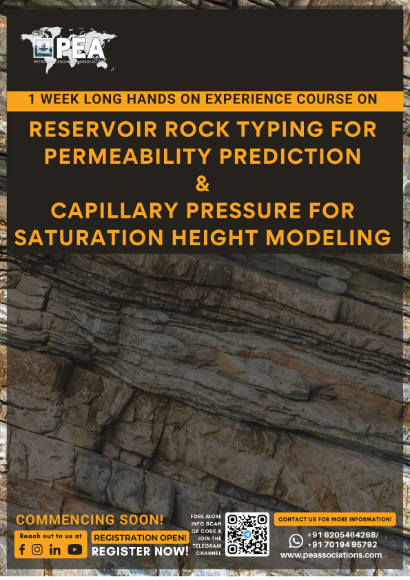
Reservoir Rock Typing for Permeability Prediction & Capillary Pressure for Saturation Height Modeling
From Core to Log: Comprehensive Training in Reservoir Characterization



Reservoir Rock Typing for Permeability Prediction & Capillary Pressure for Saturation Height Modeling
Have Questions ?
Reservoir Rock Typing for Permeability Prediction & Capillary Pressure for Saturation Height Modeling - PEA-RRT-26
| Code | Date | Time | Duration | Location | Currency | Team of 10 Per Person | Team of 7 Per Person | Early Bird Fee Per Person | Normal Fee Per Person |
|---|---|---|---|---|---|---|---|---|---|
| PEA-RRT-26 | 10 - 16 Aug 2026 | 10:30 PM Indian Time |
3 Hours Per Day
|
Zoom Online
|
USD
|
1850
|
2000
|
2500
|
3000
|
The Classes will be via Online (Zoom) from monday to Saturday with 3 hours per session.
Boost your team's skills and your budget! Enjoy group discounts for collaborative learning. Send an inquiry to info@peassociations.com.
Reservoir Rock Typing for Permeability Prediction & Capillary Pressure for Saturation Height Modeling
This course provides a detailed understanding of how reservoir rock typing, permeability prediction, and capillary pressure analysis contribute to accurate reservoir characterization and saturation height modeling. Participants will learn how to integrate core, log, and laboratory data to enhance reservoir modeling and hydrocarbon-in-place estimation.
Description
Accurate reservoir characterization requires understanding the relationship between rock properties and fluid behavior. The Reservoir Rock Typing for Permeability Prediction & Capillary Pressure for Saturation Height Modeling course focuses on identifying rock types based on geological and petrophysical characteristics and their impact on permeability and capillary pressure trends.
Participants will gain in-depth knowledge of how rock typing supports static and dynamic reservoir models, improves permeability prediction in non-cored intervals, and refines hydrocarbon saturation distribution. The course covers methods for developing saturation height functions using capillary pressure data and demonstrates how to apply these models in field-scale reservoir studies.
Practical examples and case studies are used to demonstrate data integration workflows, from core analysis to log interpretation and modeling, ensuring participants can directly apply the knowledge to real reservoir challenges.
Reservoir rock typing and capillary pressure interpretation are essential tools for translating geological variability into meaningful reservoir flow properties. Understanding how different rock types control permeability and fluid distribution enables engineers and geoscientists to make better predictions of reservoir quality and performance.
This course provides a hands-on learning experience in classifying reservoir rocks, developing permeability models, and constructing saturation height functions. It bridges geological, petrophysical, and engineering perspectives, enabling participants to create more reliable reservoir models and improve hydrocarbon volume estimations.
Understand the principles and importance of reservoir rock typing.
Identify key parameters influencing permeability and rock quality.
Integrate core, log, and laboratory data for rock type classification.
Develop permeability prediction models for uncored reservoir intervals.
Interpret and model capillary pressure data for fluid saturation estimation.
Construct saturation height models for use in static and dynamic reservoir modeling.
Apply rock typing and saturation height workflows to improve field development decisions.
The course combines instruction with interactive discussions, case studies, and hands-on exercises. Participants will analyze real datasets to perform rock typing, permeability correlation, and capillary pressure interpretation. Software demonstrations and workflow examples will help participants translate theory into practical reservoir applications.
Enhanced accuracy in reservoir characterization and modeling.
Improved hydrocarbon volume estimation and field development planning.
Reduced uncertainty in permeability and saturation prediction.
Strengthened integration between geoscience and reservoir engineering teams.
Optimized reservoir management through data-driven interpretation.
Develop advanced technical skills in rock typing and permeability modeling.
Gain expertise in interpreting and applying capillary pressure data.
Improve understanding of reservoir heterogeneity and fluid distribution.
Build proficiency in integrating geological, petrophysical, and engineering data.
Enhance professional credibility in reservoir characterization and modeling projects.
Reservoir Engineers and Geoscientists
Petrophysicists and Core Analysts
Formation Evaluation Specialists
Production and Development Engineers
Subsurface Modelers and Technical Advisors
𝗥𝗲𝘀𝗲𝗿𝘃𝗼𝗶𝗿 𝗣𝗿𝗼𝗽𝗲𝗿𝘁𝗶𝗲𝘀 𝗙𝗿𝗼𝗺 𝗖𝗼𝗻𝘃𝗲𝗻𝘁𝗶𝗼𝗻𝗮𝗹 & 𝗦𝗽𝗲𝗰𝗶𝗮𝗹 𝗖𝗼𝗿𝗲 𝗔𝗻𝗮𝗹𝘆𝘀𝗶𝘀
Core-handling, Wellsite Procedures, and Preservation Methods.
Rcal: Porosity, Permeability, Grain Density.
Scal: Saturation, Wettability, Relative Permeability and Capillary Pressure.
Electrical Properties (M and N Exponents).
𝗥𝗲𝘀𝗲𝗿𝘃𝗼𝗶𝗿 𝗣𝗿𝗼𝗽𝗲𝗿𝘁𝗶𝗲𝘀 𝗙𝗿𝗼𝗺 𝗘𝗹𝗲𝗰𝘁𝗿𝗶𝗰𝗮𝗹 𝗟𝗼𝗴𝘀:
Open Hole Log Interpretation.
Quantitative Log Analysis: Lithology, Porosity and Water Saturation.
Core Log Correlation and Comparison of Petrophysical Results to Core Data.
𝗙𝘂𝗻𝗱𝗮𝗺𝗲𝗻𝘁𝗮𝗹𝘀 𝗳𝗼𝗿 𝗥𝗼𝗰𝗸-𝘁𝘆𝗽𝗶𝗻𝗴:
Introduction to Rock-typing and Bases of ElectroFacies Analysis.
Electrofacies Identification Techniques.
Multi-well Data Analysis & RRT
Multi-wells Data Analysis
Permeability Estimation From Logs Core Data: Linear Regression & Multi Linear Regression
Reservoir Rock Typing (RRT) & FZI Calculations
Rock Types Prediction In Uncored Wells (Qualitative Variables).
Neural Network For Quantitative Variables
Data Input Selection
Learning Phase & Data Selection
Result Visualization And Quality Control Step
Apply To Others Wells (Uncored Wells) (Quantitative Variables)
Reservoir capillary pressure
The basic forces (surface tension & wettability), in the reservoir, fluid contacts, nomenclature, basic formulae, relative permeability.
Irreducible water saturation: water saturation vs porosity or permeability, uncertainty quantification.
Selection of saturation-height models leverett-j, brooks-corey, lambda, thomeer.
Workshop and software application examples
Saturation-height function creation
Model fitting, individual curve correlation method, all curves simultaneously method, problems with parameter selection
Core build model
Log apply model
On successful completion of this training course, PEA Certificate will be awarded to the delegates.
Your expert course leader is a seasoned petrophysicist with 12 years of industry experience specializing in reservoir characterization and formation evaluation. He possesses deep expertise in advanced well log interpretation, core sample analysis, and integration of petrophysical data to optimize hydrocarbon recovery. Throughout his career, he has contributed to multidisciplinary projects, providing critical petrophysical insights to exploration, appraisal, and development teams. Known for his practical application of petrophysics principles, he regularly supports data acquisition planning, quality control, and delivers high-impact technical training to oil and gas professionals worldwide. His strong collaboration skills enable effective liaison across geoscience, reservoir engineering, and drilling disciplines, driving better subsurface understanding and project success.
Frequently Asked Questions
All course bookings made through PEA are strictly non-refundable. By registering for a course, you acknowledge and accept that all fees are payable in full and are not subject to refund under any circumstances, including changes in personal or professional commitments or partial attendance.
PEA reserves the right to make reasonable adjustments to course content, trainers, or schedules where necessary, without entitling delegates to a refund. Comprehensive details of each course — including objectives, target audience, and content — are clearly outlined before enrolment, and it is the responsibility of the delegate to ensure the course's suitability prior to booking.
For any inquiries related to cancellations or bookings, please contact our support team, who will be happy to assist you.
You may also be interested in...